Showing posts with label speakers. Show all posts

Wednesday, 2 April 2014

Speaker Cabinet Restoration, Oil or Varnish?


I've been asked by a couple of people whether they should Oil or Varnish their speaker cabs.

Well the answer depends on what state your cabs are already in but ultimately you want Oil not Varnish. Varnish is a quick and cheap way to give a hard wearing protective surface but over long periods of time can flake and crack. It also doesn't feed the wood, the veneer is left underneath getting dryer and dryer. This can result in the veneer itself flaking off. Oil will feed the veneer, help prevent flaking and enrich the colour tone and depth. However oil will require more work and regular polishing to keep it at its best.

If your speakers are already varnished but in good condition with no flakes coming off, then there is little to be done. You can oil them, they will go shiny but then dull as the oil drys. The oil will sit on top of the varnish and wont feed the wood. You can varnish them again but in my opinion the best option here is to leave them alone, a regular polish will keep them nice.

If you have cabs with old varnish flaking off then you can strip the old varnish, rub them down (very lightly) and then build up layers of oil. When stripping I tend to go less paint stripper and more elbow grease. You can find elbow grease at any local hardware store... If that sounds like too much work for you then adding oil to the flakes and cracks will help the general appearance and the use of a good bees wax polish after will do wonders.

The speakers below had slight cracking in the varnish but the oil and bees wax helped a lot.


If your cabs have no varnish on them, the fun can begin straight away. A quick rub down is still advised as this will freshen the surface ready for the oil to soak in. It can also help hide any light marks and scratches.

But which oil should I use? I hear you cry.

Teak oil: Its good stuff but tends to be a bit expensive and is quite thin.

Danish oil: Another good one, very poplar, again, can be expensive but buying in bulk helps.

Linseed oil - Double Boiled: The oil of school workshops, its thick, its good value, its safe.

Personally I use Linseed Oil, it must be the double boiled stuff for the best results though. Its the thickest oil I've found and really gives a good finish. After oil the veneer has more depth, 3 dimensional glistening and improved colour tone. It also leaves a film over the whole speaker which helps protect and continues to feed the veneer. Any of the above oils, and others, will work well but after a few coats have been applied and set we must move to the next stage.

Beeswax Polish.

This is were we receive the fruits of our labor. Apply a small coating over the speaker and leave it for 10 minutes. Now buff away the residue to reveal a glorious shine, buff in the order you waxed. The longer you leave the wax on the more elbow grease you will need, hopefully you have some left from earlier.

So there you have it, bye bye varnish and hello oil. You cant beat oiling speakers on a hot sunny day!


Friday, 31 January 2014

Ekco 5768 3-Way Speakers


Acting on a tip-off from a secrete agent, I drove to a local Cash Converters to investigate some strange Ekco speakers. Something was familiar about the Ekco name and I had a feeling that these may have some nice Philips bass drivers in them. I thought I had some Ekco speakers many years ago but it was a very faint memory. When I walked in the shop I was surprised at their size, they were bigger than I was expecting, GREAT!
They had no badges on the front and the grills were impossible to remove. However I could just about see through the grill cloth and noticed the voice coil was exposed. AH! I'm sure I'd heard something about Philips bass drivers with thick rubber dust caps which disintegrate with age. 

They were in very good condition with only a couple of visible scratches, I presume these probably happened in the shop as they looked rather fresh. The other drivers were well hidden but I was fairly confident they were a 3-way system. At £19 they were soon in my car and off to their new home!


The first thing was to get those grills off! On one speaker was a gap in the corner of the aluminium trim which allowed me to get a knife blade in and leaver up the covers. OH MY! A full array of Philips drivers mounted on a rather charming, plastic veneered baffle. The dust cap was in several pieces which was a shame but otherwise everything was as it left the factory. Why Philips took the time to make the fronts so appealing and then add removable grills you couldn't physically remove, is beyond me.

The tweeter is very well known and commonly used by many manufactures in the 70s but has a poor reputation. Personally, I feel its underrated, it certainly works in this setup, even if the super sparkle is lacking slightly. The presentation is sharp and clear, with good imaging and separation.

The mid-range unit is again Philips and contained in a separate chamber. I have little to say about this unit, there's little info out there it would seem. The sound is clean and open, its not a fuzzy warm sounding thing, its fast and accurate.

The 10" bass driver is really nice and I would suspect its an AlNiCo but all the drivers are glued in place which makes a fantastic sealed enclosure but halts any further investigation. It has nice thick rubber rolled surround which is still nice and soft (unlike many Wharfdale units now).


Ekco go way back and were a big British company making TV sets and Radios. They were lagging behind slightly in the Radio market until they released a round bakelite model which was so funky and fresh, it saved the company. In later years though, the company faded away and was bought by Philips. This is why these "Ekco" speakers have "Philips" drivers I assume. More Ekco Info


So how do these £19 boxes with so called "naff tweeters" actually sound?  Quite good in my opinion.

If you are looking for warm valve like sound to use with your valve amps, forget it. While these are quite efficient, they have a very open and fresh presentation. They are crisp and delicate and certainly don't sound like "old speakers". I have only two issues with these and that's firstly: the bass. Despite having a massive 10" bass driver, they simply don't have the bottom end. They have punch and tightness but no real sub bass unless you get far away from them and play at louder levels. In the front room they worked fairly well but sitting up close in the second room didn't do them any favors, but that's fair enough I suppose. My second issue is the placement of the tweeter. Even if they didn't want to make the cabs in mirror sets, It would still be nice to have a linear arrangement. There is just about enough space on the baffle to do it, but again, if you can get away from them, it shouldn't be too much of an issue.

If you're lucky enough to find a pair you'll most likely get them for nothing, which is great. So much of this "vintage" stuff is sky rocketing now, and while that's nice on the one hand, it dose rather spoil it for those of us who simply enjoy finding a bargin and having a play with it.

Until the next time guys ;)

Sunday, 29 December 2013

B&W DM-70


Domestic Monitor 70

These were acquired from a friend. I was sent a picture message of them and that's it, they were mine. How could I resist those amazing looks! The curves, the circle in the middle, that black panel on top and dont get me started on the matching stands. And its not just the looks, the few bits of info I could find looked very promising.

12" bass drivers made by E.M.I. and a curved electrostatic panel on top. Panel made from several small panels firing out in an array. Nearly 2" thick ply baffles steamed and clamped to create a curved baffle. Bolt on, sand filled stands and a mains leads hanging out the back.

These were highly respected in their time and were the flagship offering from B&W. These speakers with such style and finesse are what turned B&W into one of the big boys. Sony was so taken with the 70s that they sold them under their name. You sometimes see speakers just like mine here but with Sony badges. I believe there is still a plate on the back of the panel which says B&W.


You can often find them on ebay but finding a nice pair, fully working and near enough for collection is hard. They go for good money but still cheap in comparison to the modern day equivalent. Its always nice to get things in good condition but I've never seen a mint pair of these. Foam on the drivers always goes and the veneer around the baffle starts flaking off in big chunks. Quite often faults in the panel resulting in popping noises and a drop in output volume.

So when buying, remember:                   POP - FLAKE - ROT


Here the drivers are awaiting re-foaming, notice the perfectly matched meter readings. Checkout the crazy over sized crossover in the middle below.


This pair had some veneer flaking but I was able to stick most of it back down and soaking the cab in linseed oil finished it off, now they are perfectly fine.

to the right:  The electrostatic power supply - high voltage inside!  The lead is short and trust me, that thing dont stretch.


The sound is good, plenty of bass and good open mid-band. Top end is extended and well defined, stereo image is a little fuzzy but overall a very good musical presentation. Are they worth the money? Well yes but you're going to need a big room to get their best.


Friday, 27 December 2013

Choosing the Best Vintage Drive Units for DIY Speakers.


How on earth do you choose which drivers to use when you have little to no technical information on the units you have available?

This is a tough one because everybody has their own taste and may require their speakers to do different things. Some may be looking for volume, others may want accuracy or maybe you'd rather an easy listening setup you can enjoy for hours. There are also other factors to consider, like budget, time frame and the physical size. Also there is a question of wood-working/electronics skills and available tools.

So lets assume you are somebody who has a fair collection of drivers and you want to build a musical system with good bass at low volumes and you don't want to spend your life savings on it. Lets say you have basic wood working skills and you have a ruff idea about speaker cross overs.

I'm of the opinion that a very good two way speaker can be achieved, and quite easily too, if you have a good source of drivers to experiment with and you don't crave a perfect flat response.

My ideal two way would be something like an 8" bass/mid in a tl and an open back tweeter sitting on top. I'd simply use a first order crossover but this will make choosing your drivers quite difficult. You want the tweeter to go fairly low aswell so you can take advantage of the "open back sound".

I think most of us would agree that a three way is going to achieve the best results so I will focus on this design method. However I'm going to suggest a rather unorthodox method for choosing drivers.

First driver to pick is the mid-range. you need to play it naked, no crossover, no cabinet. Try to keep in mind that its the mid-range were listening for, if you like the sound as it is you have a good starting point. If you don't like the sound then don't waste time on it, smash it up with a hammer and find another driver.


If you play a kef B110 naked it sounds fairly naff, well, it is a bass driver after all. However if you play an old Philips AlNiCo or an EMI ect, you should find it quite satisfying. Please don't use dome mid-ranges here unless you really like them for some reason. You want to try and go paper cone, with paper surround and AlNiCo if you like.

Now you need a tweeter. I do a similar thing as the mid but I use a single capacitor in series with the tweeter to protect it. I would start with a 4.7uf for 8ohm tweeter and keep the volume low. Try and pick several tweeter options from this test so you can choose the "perfect one" latter on. A Kef T27 sounds like crap here but a pair of decent paper cone open backs should sound glorious. Open back tweeters can be hard to find but a decent AlNiCo dome like the one below will work very well in most cases.


PLEASE NOTE: If you have a 16ohm tweeter the 4.7uf cap wont filter as well so I would use a 2uf. Likewise, if you have a 4ohm tweeter the 4.7uf could filter too much and you wont get the natural sound of the tweeter.

Now you need a bass driver. Go no smaller than an 8" and personally I would use a kef b200 if your other drivers are of similar sensitivity. When choosing a bass driver you want a very low resonance. If you hold the speaker to your ear and tap the edge of the cone you will hear a nice bass thud. The lower the tone the better. I always look for something around 20-30hz but the cabinet you place it in later will change this value. A small sealed box will increase the resonant frequency. So if your building a small bookshelf speaker, a driver with 60hz resonance will be fine. I personally would only ever use a transmission line for the bass because I can't resist that deep rumble organ bass.

Now you have at least three drivers, you can have a quick listen to them all together using an existing 3-way crossover network from an old speaker system. If you hear peaks in the spectrum, try reversing the polarity of the drivers until it sounds right. This is only ruff but you should be getting an idea of how well matched your selected drivers are in terms of sensitivity.

From this you should now have three drivers your happy with. Now you need to build your enclosure and I'm leaving that part up to you. But lets say you are using a transmission line for the bass and the mid and tweeter will sit on top open back.

Fit your drivers in place and start the lengthy process of making your crossover, by ear if you're feeling brave. Building a speaker in this way means you are constantly  playing with values and you really get a feel for what the individual components are doing. I have been playing with crossovers for months in some cases. You can of course use a cross-over calculator which are plentiful online. These don't allow for the sound you will actually hear in your listening room but are certainly a very good starting point.

Im sure many will disagree with this method of building speakers but Its more fun and you can tailor the sound to your preference. Would you rather sit on the computer looking at numbers or sit on the floor surrounded with vintage drivers?

Let the MUSIC flow!


Amazing Alnico Speakers


First off, what are we even talking about?

Well, we mean the type of magnet used in a speaker drive unit. Any conventional driver will use a magnet. There are two types commonly used: AlNiCo and Ceramic.

There's quite a fan base for these vintage drive units and many claim they sound better than ceramic speakers. The question is do they actually sound better and if so why? This stir in the HiFi underworld appears to have been noticed by today's companies, who now offer their own AlNiCo units. So is there something in it?


What is Al-Ni-Co (Aluminum-Nickel-Cobalt)

Its an alloy magnet system and was very common in the 60s. Its more expensive than ceramic magnet material, so logic would dictate that it was used for a reason. Saba, Isophon, Goodmans, all top manufactures back in the day and all of them used AlNiCo magnets in many of their drive units.


"the AlNiCo sound"

This is all about compression and it only happens due to the nature of the AlNiCo magnet.


AlNiCo magnet has a delicate magnetic field, easilly drained by other forces. So when you send a signal to the voice coil in a speaker, you are generating an opposite magnetic field. The field generated in the coil pushes away from the AlNiCo field, causing the cone to push out. When you swap the polarity, the reversal happens.

The field in the coil is also interacting with the AlNiCo, it looses some of its power as the coils field is present.

When playing music, the louder the volume the greater the field in the coil. The AlNiCo magnet is constant but the coils field is jumping around and switching direction. The bigger the coils field, the more power sapped from the AlNiCo.


So to recap, when the fields are interfering, the voice coil field weakens the AlNiCo magnets field. As you increase the signal, the greater you weaken the AlNiCo.

If you weaken the magnet on a speaker, it becomes less efficient (you get less output volume). This is happening with every movement of the voice coil, tiny tiny amounts and at extremely high speeds.

So the AlNiCo magnet system is smoothing the sound, or, to be more accurate, compressing.

So there is a difference with AlNiCo speakers and to my ears they do sound "better" but of course there are many other elements to a speaker and a well designed ceramic speaker will sound better than a poorly designed AlNiCo.

Wednesday, 18 December 2013

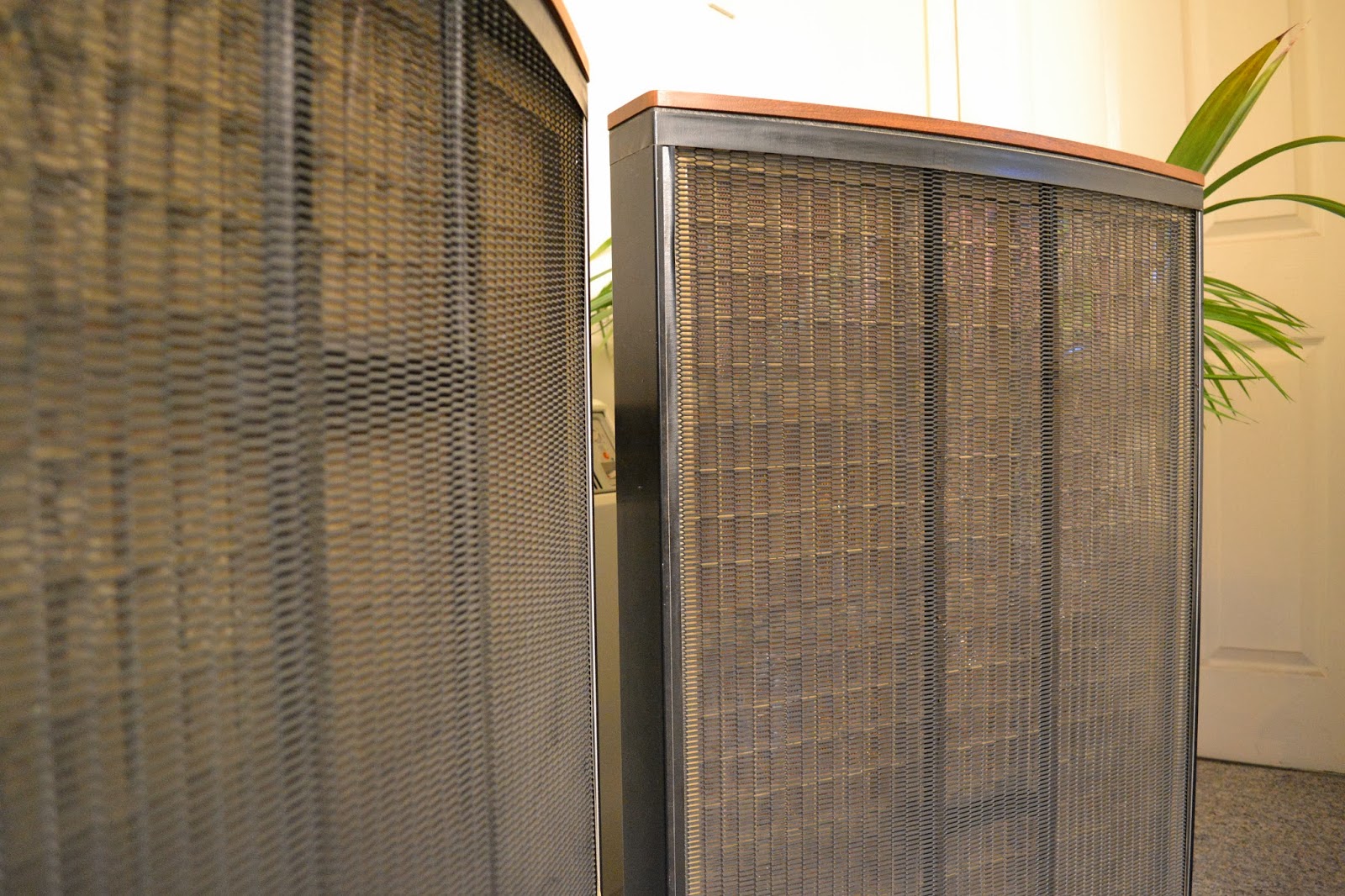
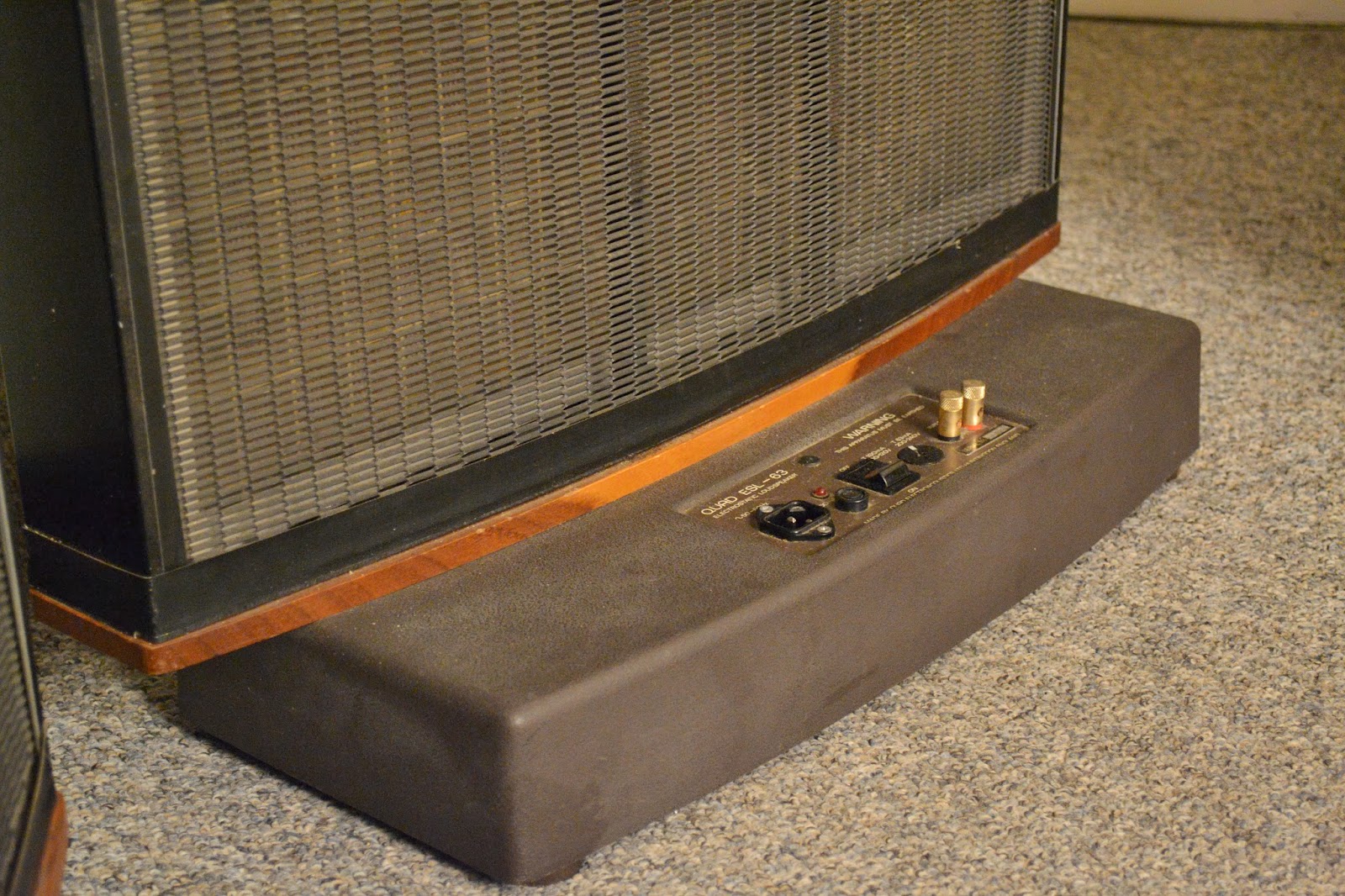
QUAD ESL-63 Electrostatic Speakers


I was walking round a boot fair one day and what stood before my mortal eyes? 
Quad ESL-63... Life is good sometimes...

Got them home, plugged them in, gave them an hour to warm up. Sadly there was some slight popping from one but I had to push on and hear what these could do. I had a Sansui BA-2000 hanging around so I used this to test them, I also used my Creek CD60 as a source.

I was hoping for something amazing from these as the little research Id done had revealed a wealth of information and dedicated fan base for these lovely speakers. Some were even calling the ESL-63 the best speaker of all time.

From the moment I first heard them I knew they were different from anything Id heard before. The sound was so open and realistic. The top end was smooth yet detailed but maybe lacking a little in the extreme. The bass was very impressive, in the right position with good equipment, you wont be disappointed. I was having a whale of a time but I couldn't help but feel there was something wrong. I was enjoying the listening experience but I grew a little tired of the sound-stage. Everything was so everywhere for me, I could hear all the instruments but struggled to pin point their position in the stereo image. I also knew that they would never blow my socks off or shake the house with transmission line rumble.


So how would I sum up these wonderful speakers that people pay thousands for?   Easy

If you have the money and you love that electrostatic sound, I'd go for these because Im sure nothing will bring you more electrostatic pleasure than these or maybe the more mellow sounding ESL-57? 
I'm no electrostatic expert but on the rare occasions I've heard them, I always feel the same: nice but not what I'm looking for.


So overall a wonderful sound and a great musical presentation. Lovely warm bass which must extend down to 40hz at times. Such a smooth sound but with all of the detail, a very tricky balance but the confused stereo image did spoil things for me a little. If you like jazz and classical you're in for a real treat and these would certainly then be one of the greatest speakers ever but personally I remain firmly perched on the fence.

Until the next time...

Monday, 9 December 2013

Bowers & Wilkins DM1


B&W DM1

A few weeks ago I came across a pair of DM1 speakers in a local cash converters. My eyes lit up when I spotted them but I was soon put off when I saw a price tag of £100 on them. Dam, what a shame I thought. I made them a silly offer but left empty handed.

When I got home I was surprised to see that the DM1 were fetching more money than I had previously thought and £100 wasn't that unreasonable after all.

Anyway, today I have returned home with them safely wrapped up in blankets. They have a few marks here and there but overall very good condition and more importantly the drivers are all working.

The Domestic Monitor 1 - circa 1968

3 way infinite baffle, EMI bass driver, Celestion HF-1300 MKII and Coles super tweeter.

This was one of the first mass production speaker designs from B&W, along with the DM3. There was an earlier model called the P1 which used an EMI and Celestion in a two way big box design. The sales from the P1 were used to purchase test equipment which was used to accurately measure the new speaker designs, namely DM1 and DM3.

B&W DM1

First off, the EMI bass driver. I can't tell you just how good EMI drivers are. Most people are aware of the fiber glass materials used in the cone construction but what you don't hear so often is the dual cone materials. The middle of the cone is made from a piece of thin aluminium and then a paper/glass fiber cone is fitted around that, yes "around it". EMI drivers are simply divine, made by master craftsmen and appreciated only by the most discerning "music" lovers.

Now, the EMI used in this system is 10x6" and it has 4 foam squares to lower the cones resonance. According to sources on the net, each square weighs 1g. Also the cones surround is some kind of polymer/pvc material with a narrow double rolled edge.

As the unit is mated with a HF-1300 you know there's going to be a fair bit of mid-range produced by the EMI and its glorious!

B&W DM1

The HF-1300 is the MKII version which is a different kettle of fish compared to the standard 4ohm cheap version found in later Dittons. The MKII has AlNiCo magnet system and is 16ohms (I think).

B&W DM1

The Super Tweeter is usually a Coles 4001g but the earlier models have a slightly different version with different suspension, a hole in the center pole and a flattened dome. The assembly is slightly recessed into the face plate aswell. I don't know exactly what they are but these are the ones to have. Watch out though, they will blow if your not careful.

I'm listening to these as I type and I'm sure many of you will be interested to hear how they sound. Well, I had fairly high hopes as people had been comparing these to Rogers Ls3/5a and other well established speakers. I have also seen people calling the DM1 a BBC monitor but I have found no evidence of that "yet".

B&W DM1B&W DM1

The sound, is breathtaking! The first second I heard them, I knew they were special. The mid-range is very lush. Imagine bubbles made from a very sticky liquid popping in your ear. They are very open with extremely good top end response. The bass is a little shy but I honestly don't care, they are sublime and the bass is all there just not the earth shattering stuff. The bass is clean and clear, the whole presentation is very fresh and yet musical. I don't want to ever unplug them!


Personally I'd never use a pair of Ls3/5a instead of these, Im not saying the Rogers are not as good but I could never love them like I love these.

This is me - In a state of bliss. Untill the next time guys...


Tuesday, 29 January 2013

Ruark Crusader II Speakers


Ruark Crusader II Floor-Standers

Id heard of Ruark and knew they were well respected but these speakers were surely too modern to be worthy of my time, or maybe?


Well first off, Im open to anything and the build quality of these gave me high expectations. I hooked them up to my old skandia receiver (1969, 8w a chan). Com'on then, lets see what you've got.


Wow, blown away with glorious mid-range, detail bursting in front of me. Lovely smooth bass, really tuneful and the top end was very subtle, so analogue. I was convinced!

So they past the "musical test" but what about fidelity? Out comes the Pioneer SA-9900.
Holy crap, that mid range detail really is first class. The top is all there now, even if the upper extreme is a little shy. All the detail was there, I never missed anything but it wasn't quite right. The bass was a little thin and lacked the bottom end I so loved from my transmission lines.

Out comes the Sansui AU-919.
Basically the same story, its all there but I cant live without that bass. Everything else about them is spot on. I like a very warm sound with all the detail and these were very good, they could have been warmer but they were clean, clear, crisp and with punch and for their size have good tuneful bass when mated with the right amp.


To sum up. If you fancy a pair, go for it, they are very good. I haven't heard the Ruark talisman but I should imagine the mid-range is the main improvement to be had when "upgrading" to the Crusader.

An interesting thing to point out is the Skandia. It was by no means the "best" sound, the top end rolls off, its "under powered" and its now 40 years past its prime. But that bloody thing is just so dam good, and thats the point of your hifi, you dont have to conform to this one "perfect" sound. If you like playing your music on a 1920s gramophone, do it and enjoy the experience. If you do use a gramophone please comment because thats awesome!


Specifications Ruark Crusader II
System Type: Bass reflex, 3 way
Drive units:
Bass: 180 mm precision cast magnesium chassis, high flux magnet assembly, high temp 40 mm Kapton voice coil.
Mid-range: 75 mm treated fabric dome, vented center pole. Aluminium voice coil.
Tweeter: 25mm trated silk dome.
Frequency Response: 40 Hz - 20 khz ±3 dB
Sensibility: 88dB / 1Watt
Crossover Frequency: 500 Hz; 4 kHz (Precision audio grade components a 15 elements)
Nominal Impedance: 8 ohms
Recommended amplifier power: 25 - 100W
Cabinet: Floor standing ACD, Critically damped MDF double layer construction
Colour Finishes: Veneers in; natural Cherry, Natural Oak, Walnut, Rosewood and Black Oak
Dimensions (HxWxD): 900 x 235 x 320 mm
Weight: 30 Kgs each
Made in UK